It was lost at 9: 01pm, not at the negotiation table. And it will not show up in any report, because nothing visibly broke. The phone still rings. Listings still get views. But money is leaving the business every week, quietly, through a gap most owners cannot see.
Most property businesses believe they lose deals on price or location. They don't. They lose them in the silence between an inquiry and a reply. Across founder-led property firms in Kampala and Kigali, our working estimate is blunt.
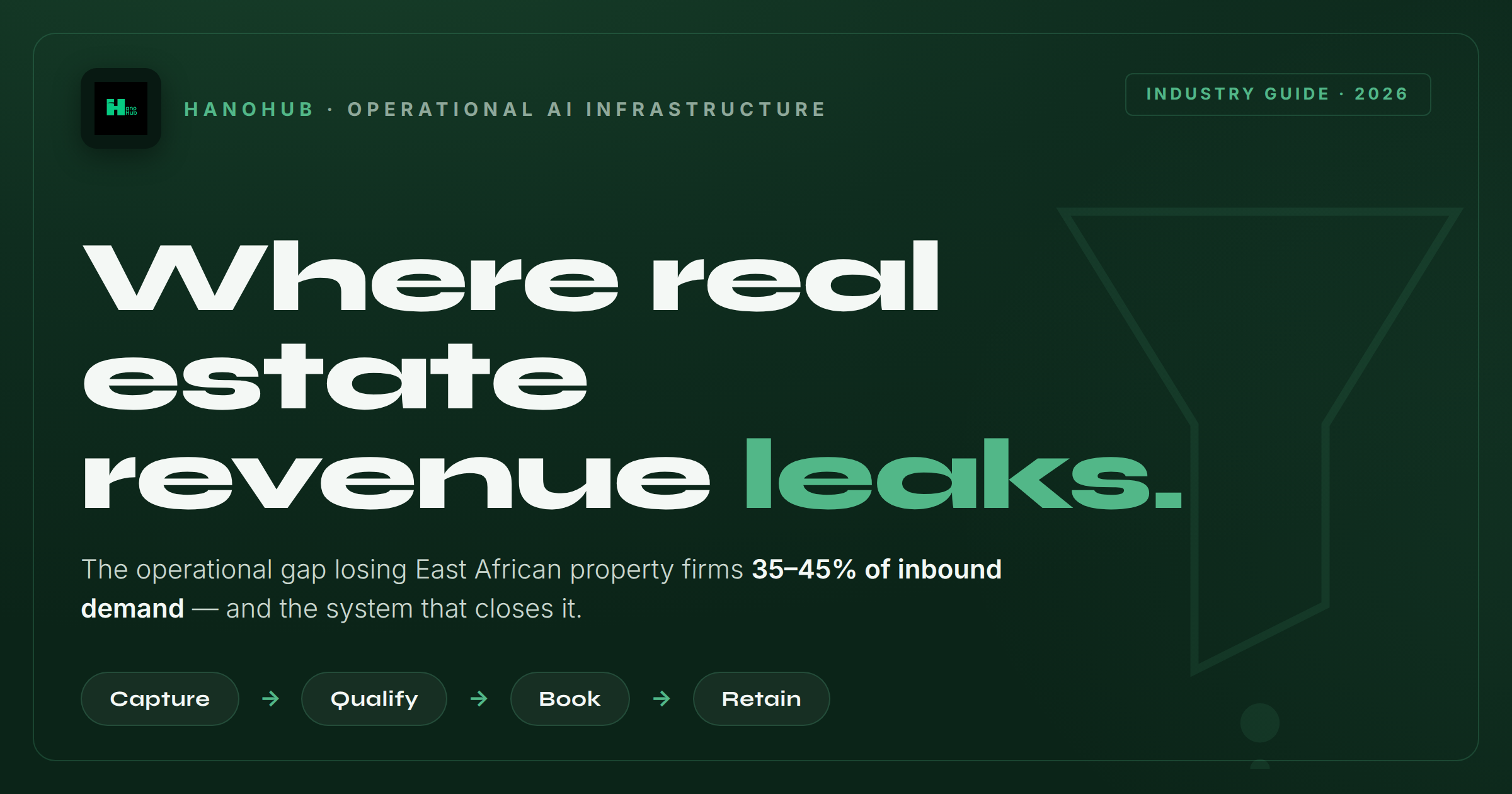
35–45% of inbound property demand leaks before a qualified conversation ever happens. Not lost to competitors on merit, lost to slowness, office hours, and follow-up that never gets done.
Deals don't leak on price, they leak on silence
Revenue rarely disappears in one dramatic moment. It drains at the handoffs: the moment an inquiry arrives, the moment it needs screening, the moment a viewing should be booked, the moment a quiet buyer should be followed up. Each handoff looks like ordinary business. Together, they are where the pipeline empties out.
This is what we call operational revenue leakage, and naming it is the first step to closing it. The four places real estate revenue leaks Demand does not leak in one place. It leaks at four operational points, and most firms cannot see any of them.
01 CAPTURE The after-hours gap. Most inquiries arrive outside working hours, on WhatsApp. Left until morning, most have already moved on.
02 QUALIFY Manual screening. Agents burn hours on buyers who were never going to transact, while serious buyers wait.
03 BOOK Friction to the calendar. Every extra step between interest and a scheduled viewing loses buyers. Interest is perishable.
04 RETAIN No follow-up system. Most buyers who don't transact this month are never contacted again, the pipeline is rebuilt from scratch.
Why East Africa makes the leak bigger
Three structural realities make this gap wider here than in most markets, and make closing it more valuable.
Buyers are mobile-first and message-led. They reach out on WhatsApp, after hours, expecting a same-evening reply. A firm built around office hours and email is mismatched to how demand actually arrives.
Demand is increasingly diaspora-driven. Uganda's diaspora sent home a record USD 2.5 billion in 2025, about 3.8% of GDP Bank of Uganda). A meaningful share funds property and construction, and those buyers operate across time zones. They cannot wait for office hours, and they judge a firm by how fast and how credibly it replies.
Due-diligence friction is high. Mailo and bibanja land, title verification, URSB and RDB processes, the questions buyers ask before committing are heavy. Firms that answer them instantly win trust; firms that answer slowly lose it.
The real cost of doing nothing
The firm you are really competing with is not the agency down the road. It is your own current way of working, and it wins most of the time. Doing nothing feels free. It isn't.
Take a representative agency handling 200 inquiries a month. If 45% arrive after hours and a third of those go cold before anyone replies, that is roughly 30 lost inquiries every month — and at modest close and commission rates, that points to recoverable revenue in the order of UGX 12M a month. Every month of delay is a month of paying the leak instead of fixing it. Illustrative model; your real numbers replace these assumptions.)
Capture → Qualify → Book → Retain: the system that closes the gap
The fix is not another marketing campaign or another hire. It is one operational layer doing four jobs continuously, on WhatsApp first, where the demand lives:
Capture — every inquiry answered in seconds, day or night. No buyer waits for morning.
Qualify — each lead screened against your criteria before it reaches your team, so people only talk to serious buyers.
Book — qualified buyers guided to a scheduled viewing without back-and-forth, while interest is still warm.
This is infrastructure, not a campaign. It runs continuously, it is measurable, and it does not take leave.
Find your own leak in 10 minutes
You don't need a guide to tell you demand is slipping. You need to know how much, and where. Our full industry guide breaks down each handoff with a worked model for East African firms — and the first step to fixing it takes ten minutes.
Read the full guide: Where real estate revenue leaks.
The operational state of East African property, Kampala and Kigali as the working case study, and the four-stage system that recovers lost demand. Deployment in 14 days, with a 30-day refund if it doesn't perform.
Read the guide https://www.hanohub.com/assets/HanoHub_Real_Estate_Operations_Guide.pdf → Or book a 10-minute operational audit, we quantify your leak, no demo, no proposal. Book the audit