They are killed by operational risks nobody wants to talk about.
Founders obsess over:
• fundraising
• branding
• growth hacks
• PR
• AI buzzwords
Meanwhile the real business is quietly breaking underneath.
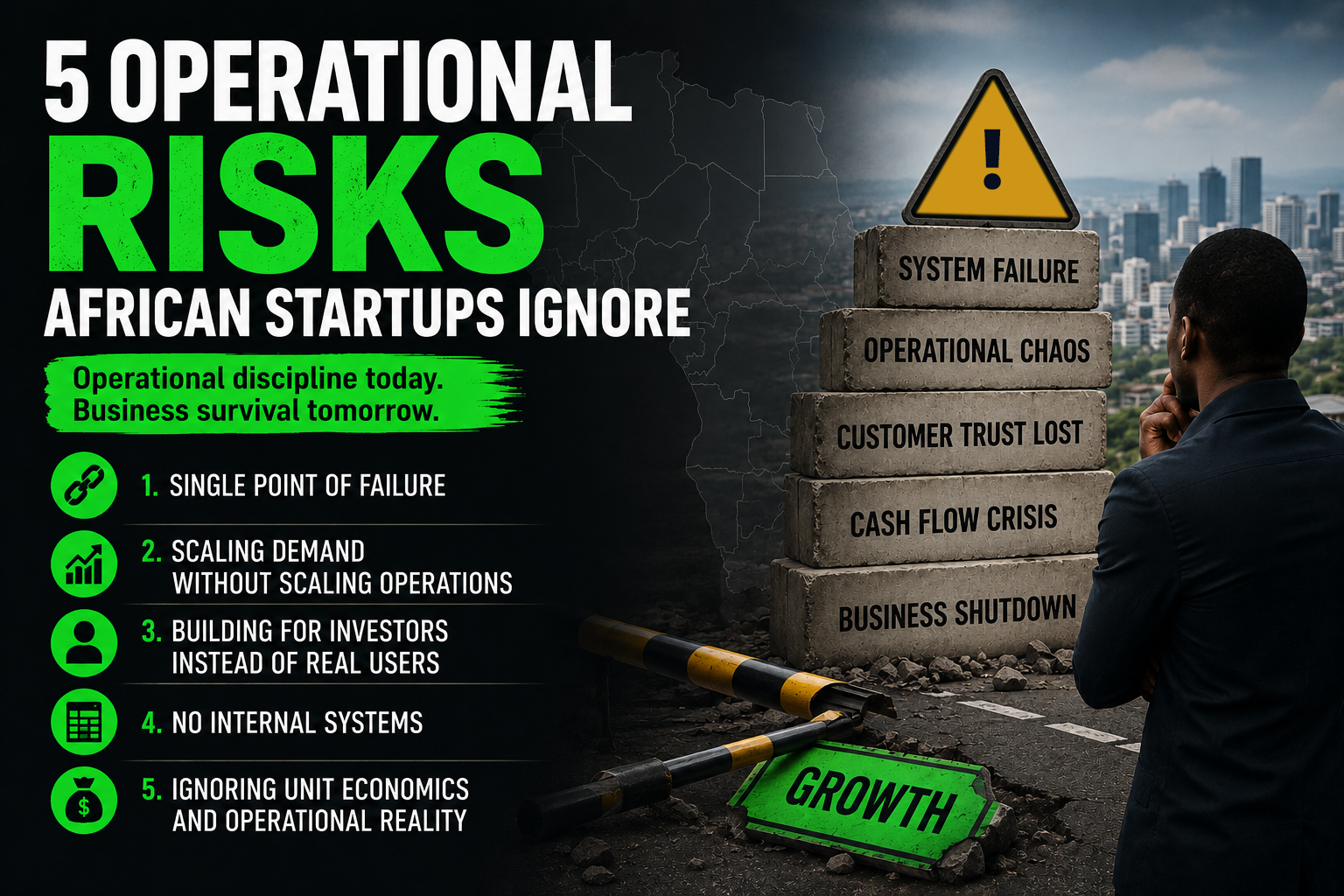
Here are 5 operational risks African startups keep ignoring:
SINGLE POINT OF FAILURE
One payment provider.
One logistics partner.
One engineer who “knows the whole system.”
One WhatsApp admin.
One supplier.
Then one disruption happens, and the company freezes overnight.
When Union54’s infrastructure problems affected virtual cards, multiple African fintechs including Flutterwave-linked services, Eversend, Payday, and others were disrupted at the same time. Entire customer experiences collapsed together because too many companies depended on the same operational layer.
That is not a tech issue.
That is operational concentration risk.
If one dependency can pause your entire company, you do not have a business system.
You have a fragile chain.
SCALING DEMAND WITHOUT SCALING OPERATIONS
Many startups celebrate growth before building operational resilience.
More customers.
More orders.
More traffic.
But:
• no process documentation
• weak customer support
• poor dispatch systems
• no workflow automation
• no internal visibility
Jumia Food expanded aggressively across African markets but eventually shut down operations in multiple countries after struggling with logistics economics and operational execution.
Growth without operational discipline becomes expensive chaos.
Operational infrastructure matters more than pitch decks.
BUILDING FOR INVESTORS INSTEAD OF REAL USERS
This is becoming common in African tech.
Products optimized for:
• demo days
• valuation stories
• investor narratives
Instead of:
• reliability
• workflow reality
• customer retention
• operational trust
Many founders underestimate how African users think:
If your service fails once during an important moment, trust disappears immediately.
Especially in fintech, logistics, health, and commerce.
In African markets, trust is infrastructure.
And operational inconsistency destroys trust faster than bad marketing.
NO INTERNAL SYSTEMS
A shocking number of startups still run core operations through:
• WhatsApp
• spreadsheets
• scattered approvals
• manual follow-ups
• undocumented processes
It works at 5 employees.
It breaks at 50.
One founder in East Africa recently described how many operational businesses still rely on disconnected workflows, paper tracking, and manual coordination even while presenting themselves as “modern tech companies.”
Most startups do not actually need more AI.
They need:
• process visibility
• accountability systems
• automation layers
• operational documentation
• customer tracking systems
Without systems, scaling only multiplies confusion.
IGNORING UNIT ECONOMICS AND OPERATIONAL REALITY
Many African startups copy Silicon Valley growth models without adapting to African infrastructure realities.
But Africa has:
• traffic chaos
• unreliable addressing systems
• fragmented payments
• unstable logistics
• fuel volatility
• inconsistent internet access
Your operations cannot behave like San Francisco.
Jumia’s logistics struggles repeatedly showed that operational realities in African markets are fundamentally different and much harder to standardize.
The startups that survive in Africa will not necessarily be the loudest.
They will be the ones with:
• resilient systems
• operational redundancy
• reliable execution
• customer trust
• infrastructure thinking
African founders need to stop asking:
“How do we grow faster?”
And start asking:
“How do we keep operating when things fail?”
Because at scale, operational failures become trust failures.
And trust is the real currency in African business.