Most
businesses are obsessed with growth.
More
leads.
More customers.
More revenue.
More visibility.
But very
few are building systems that can survive pressure.
And
that’s becoming one of the biggest hidden risks in modern business.
At
HanoHub, we’ve noticed a pattern across startups, agencies, e-commerce brands,
and even established companies across Africa:
The
businesses growing the fastest are not always the businesses that last the
longest.
Why?
Because
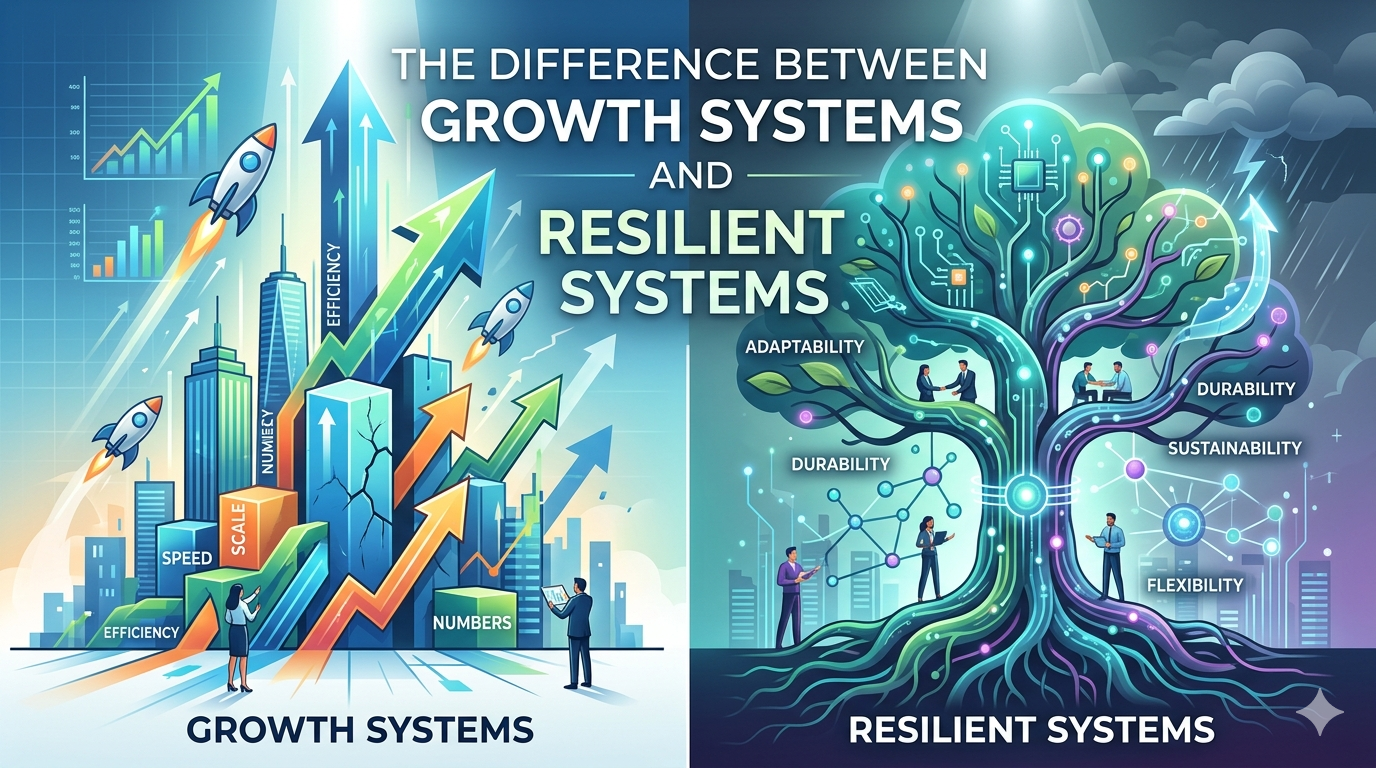
growth systems and resilient systems are not the same thing.
What Are Growth Systems?
Growth
systems are designed to increase output.
Their
primary job is to help a business move faster, acquire more customers, generate
more sales, and scale operations.
Examples
include:
- Lead generation funnels
- Paid advertising campaigns
- Sales outreach systems
- Viral content engines
- CRM automations
- High-volume customer acquisition workflows
These
systems are important. Every ambitious company needs them.
But
growth systems are often optimized for speed — not stability.
That
becomes dangerous when markets change.
The Problem With Growth-Only Thinking
A
business can appear successful while quietly becoming fragile underneath.
Here’s
what that looks like:
- One employee handles critical operations
manually
- Customer support depends on a single person
- Sales stop immediately when ads are paused
- Knowledge exists only in WhatsApp chats
- Processes are undocumented
- Data is scattered across tools
- Teams are overloaded and reactive
Everything
works… until pressure arrives.
And
pressure always arrives.
A market
shift.
A cash flow issue.
A platform ban.
A competitor.
A key employee leaving.
An economic slowdown.
That’s
when businesses discover whether they built momentum or dependency.
What Are Resilient Systems?
Resilient
systems are designed to help a business continue operating under stress.
Their
purpose is not just growth.
Their purpose is continuity.
A
resilient business can absorb disruption without collapsing internally.
That
usually means:
- Processes are documented
- Operations are automated
- Knowledge is centralized
- Teams can function without constant
supervision
- Customer communication remains consistent
- Data flows are structured
- Decision-making is visible and trackable
- Critical functions are not dependent on one
person
Resilience
creates operational stability.
And
operational stability creates long-term growth.
The Companies Winning Long-Term Are Building Both
The
strongest companies today are combining:
Growth Infrastructure
Systems
that generate demand and revenue.
AND
Resilience Infrastructure
Systems
that protect operations during uncertainty.
This is
where many businesses in Africa are currently exposed.
A lot of
companies are still operating on founder energy instead of operational systems.
That
works in early stages.
It breaks at scale.
You
cannot sustainably scale chaos.
AI Is Changing This Faster Than Most Businesses Realize
The
companies adopting AI successfully are not simply using AI tools.
They are
redesigning workflows.
There’s a
major difference.
Adding AI
to a broken process only helps you fail faster.
But
integrating AI into resilient operational systems creates leverage.
For
example:
- AI-powered support systems reduce dependency
on manual responses
- Automated lead qualification improves sales
consistency
- Internal AI knowledge bases preserve
organizational intelligence
- Workflow automations reduce operational
bottlenecks
- AI reporting systems improve decision speed
This is
not about replacing people.
It’s
about reducing operational fragility.
The Real Competitive Advantage in 2026
The next
generation of winning businesses will not necessarily be the loudest brands.
They will
be the businesses that:
- Adapt quickly
- Recover quickly
- Operate efficiently
- Maintain consistency under pressure
- Scale without operational collapse
In other
words:
The
future belongs to resilient companies.
Growth
gets attention.
Resilience keeps businesses alive long enough to dominate.
Final Thought
Most
founders ask:
“How do
we grow faster?”
Very few
ask:
“How do
we keep operating effectively when things go wrong?”
That
second question is becoming more important every year.
Because
in modern business, resilience is no longer optional infrastructure.
It is a
competitive advantage.
Written by HanoHub
Building AI-powered systems that help African businesses scale with structure,
automation, and resilience.